Will Air Purification Systems Increase Energy Bills?
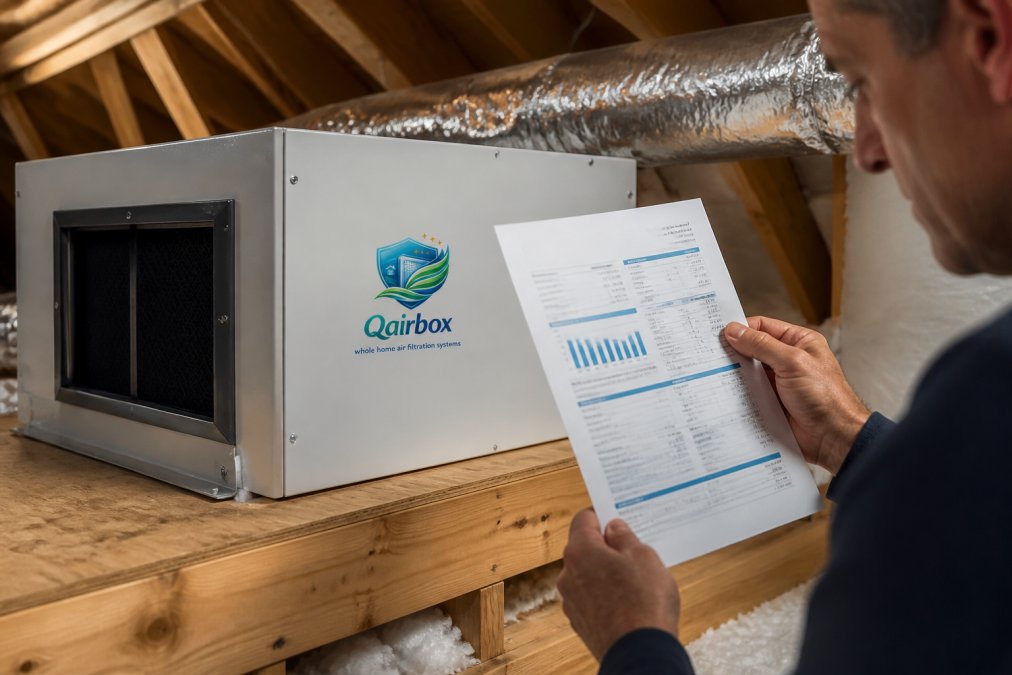
Table of Contents
- Do Air Purification Systems Really Increase Energy Bills?
- How Much Does It Cost to Run an Air Purifier 24/7?
- Factors That Affect Your Air Purification Energy Consumption
- Energy Efficient Air Purification Solutions for Your Home
- Calculating Your Specific Monthly Energy Cost
- Air Purifiers vs. Other Household Appliances: Energy Comparison
- Will a Whole-Home System Affect Your HVAC Efficiency?
- Conclusion
Last Updated: August 24, 2026
Do Air Purification Systems Really Increase Energy Bills?
Homeowners often worry that adding air purification will spike their electricity costs. The concern is understandable, running equipment 24/7 sounds expensive. But the reality is more nuanced. Whether air purification systems increase energy bills depends entirely on the type of system you choose, how you operate it, and what you're comparing it against.
A standalone whole-home air purification system installed in your attic operates independently from your existing HVAC setup. It doesn't modify or strain your central air conditioning. This matters because it means you're not forcing your existing system to work harder, you're adding a separate, purpose-built unit that handles its own air cleaning task. That's fundamentally different from retrofit solutions that add resistance to your ductwork or burden your AC motor.
The question isn't whether purification costs anything to run. It does. The real question is whether that cost is worth what you get in return, and how it compares to alternatives like portable room units or doing nothing at all.
How Much Does It Cost to Run an Air Purifier 24/7?
The monthly cost to run a whole-home air purification system depends on three primary factors: the unit's power consumption in watts, your local electricity rate, and how many hours per month it operates. Most whole-home systems draw between 300 and 600 watts when running at standard speed, though this varies by model and fan setting (energy.gov).
To calculate your specific cost, you need to know your kilowatt-hour rate. This appears on your utility bill and varies significantly by region and season. A homeowner paying 12 cents per kilowatt-hour will see different costs than someone paying 18 cents. The difference compounds over a year.
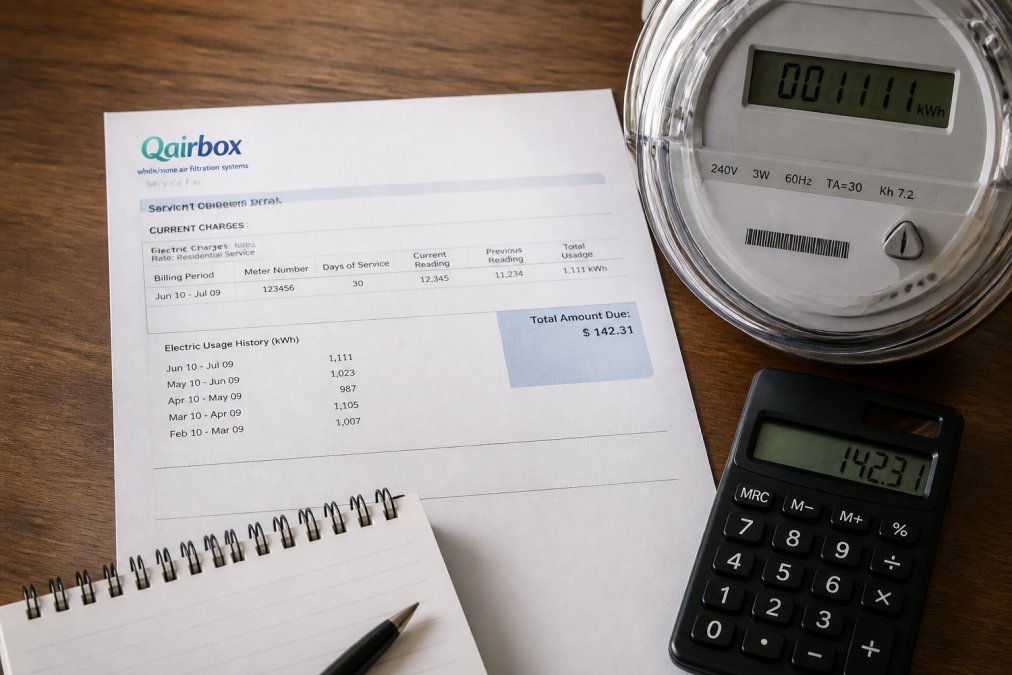
Here's the math in practical terms. If your system draws 400 watts and runs continuously for a month (720 hours), that's 288 kilowatt-hours of consumption. At 15 cents per kilowatt-hour, your monthly cost would be roughly $43. Running the same system for a year would total around $516 in electricity alone.
That number sounds significant until you compare it to context. Most households spend between $100 and $200 monthly on total electricity. A whole-home system adding $40 to $60 per month represents a 5-10% increase for most homeowners, noticeable but not transformative.
The cost also depends on whether you run the system continuously or on a schedule. Some homeowners run their systems at lower fan speeds during sleeping hours and ramp up during waking hours. This reduces energy consumption without sacrificing air quality coverage. Others run at full speed 24/7 for maximum filtration. Your usage pattern directly affects your monthly bill.
Factors That Affect Your Air Purification Energy Consumption
Not all air purification systems consume electricity at the same rate. Several variables influence how much power your system draws and how efficiently it operates.
Fan Speed Settings and CADR Ratings
The fan speed you select has the biggest impact on energy consumption. Most systems offer multiple speed settings, typically low, medium, and high. Running on low speed might draw 200 watts, while high speed could pull 500 watts or more. The relationship is not linear. Doubling the fan speed doesn't double energy use, but it increases it substantially.
CADR, or Clean Air Delivery Rate, measures how quickly a system cleans the air in a given space. Higher CADR ratings indicate more aggressive filtration. A system with a CADR of 300 removes contaminants faster than one with a CADR of 150, but it also consumes more power to achieve that performance.
The practical trade-off is simple: if you run your system on medium speed instead of high, you reduce energy consumption by 20-30% with only a modest reduction in filtration speed. For many households, medium speed is sufficient for daily operation, with high speed reserved for high-pollen days or after cooking.
Filter Condition and Motor Strain
A clean filter requires less power to push air through than a clogged one. As filters accumulate dust and particulates, they create resistance. Your system's motor must work harder to maintain airflow. This increased motor strain translates directly to higher wattage consumption.
A filter that hasn't been serviced in six months might draw 15-20% more power than a freshly replaced one (peer-reviewed research). Over time, this creeping increase in energy use goes unnoticed because it happens gradually. Regular filter replacement, typically every three to six months depending on your environment, keeps your system operating at peak efficiency.
Desert climates with high dust loads see filter clogging faster than humid regions. Homes with pets, active cooking, or smokers accumulate filter debris more quickly. If you live in a dusty area, factor in more frequent filter changes to maintain energy efficiency. This is one area where maintenance directly reduces your operating costs.
System Type: Standalone vs. HVAC Integration
This distinction is crucial for understanding how air purification systems increase energy bills, or don't.
A standalone whole-home system installed in your attic operates completely independently. It has its own motor, its own power draw, and its own ductwork. It doesn't interact with your central air conditioning system. You pay for the electricity it consumes, period. There's no secondary effect on your HVAC efficiency because the two systems don't touch.
In contrast, retrofit systems that integrate with your existing HVAC create a different cost dynamic. These systems add filtration stages inside your ductwork or furnace. They increase static pressure, the resistance air encounters as it flows through your system. Your HVAC motor must work harder to push air through the additional filter stages. This increases your AC's power consumption, which adds to your cooling costs.
A standalone system avoids this problem entirely. Your AC runs as it always has. Your purification system runs on its own schedule and power circuit. They don't interfere with each other.
Energy Efficient Air Purification Solutions for Your Home
If energy consumption concerns you, several approaches reduce operating costs without sacrificing air quality.
The first is scheduling. Run your system at lower speeds during off-peak hours and higher speeds when you're home and awake. Many modern systems offer programmable schedules or smart-home integration that automates this. You might run low speed overnight, medium during working hours, and high during evening hours when your family is gathered in common areas.
The second is filter maintenance discipline. Inspect your filters monthly and replace them on schedule, not when they look visibly clogged, but at the manufacturer's recommended interval. This keeps your motor from overworking and maintains your system's efficiency rating.
The third is choosing a system designed for your home's size and layout. An oversized system consumes more power than necessary. An undersized one must run at higher speeds to achieve adequate coverage. Proper sizing ensures you're not paying for excess capacity you don't need.
A standalone whole-home system like Qairbox delivers hospital-grade purification throughout your entire home without modifying your existing HVAC. Because it operates independently, you control its energy consumption directly through fan speed and schedule settings. You're not paying the hidden cost of increased HVAC strain that retrofit systems impose.
Calculating Your Specific Monthly Energy Cost
To determine your actual monthly cost, you need three pieces of information: your system's wattage at your typical operating speed, your local electricity rate in dollars per kilowatt-hour, and how many hours per month you run the system.
Find your electricity rate on your utility bill. It's usually listed as a per-kilowatt-hour charge. Multiply your system's wattage by the hours you run it monthly, divide by 1,000 to convert to kilowatt-hours, then multiply by your rate.
Here's the formula: (Wattage × Monthly Hours ÷ 1,000) × Rate per kWh = Monthly Cost
Example: A 400-watt system running 24/7 for 30 days consumes 288 kilowatt-hours. At $0.15 per kilowatt-hour, that's $43.20 monthly or about $518 annually.
If you run the same system at medium speed (300 watts) instead, consumption drops to 216 kilowatt-hours monthly, costing about $32.40, a savings of nearly $130 per year.
Regional variation matters significantly. A homeowner in a state with 10-cent kilowatt-hour rates pays roughly $35 monthly for that 400-watt system. Someone in a region with 20-cent rates pays $58 monthly for the same equipment. That's a $276 annual difference for identical usage.
Air Purifiers vs. Other Household Appliances: Energy Comparison
Putting air purifier costs in context helps clarify whether they're a significant burden on your energy bill.
A typical refrigerator runs 24/7 and consumes 150-600 watts depending on age and size (energy.gov). A window air conditioning unit draws 500-1,500 watts when running. A clothes dryer uses 2,000-5,000 watts per load. A water heater consumes 4,000-5,500 watts during heating cycles.
A whole-home air purification system drawing 400 watts is more efficient than running a window AC unit but less efficient than a refrigerator. The key difference is that you control when your purifier runs. You can schedule it for off-peak hours or adjust fan speed. Your refrigerator and water heater don't have that flexibility.
Over a year, a 400-watt purifier running continuously consumes about 3,500 kilowatt-hours. A typical household uses 10,000-11,000 kilowatt-hours annually. Your purifier would represent roughly 30-35% of your total consumption if it were your only electrical load. But it's not. It's one device among dozens. Its actual contribution to your overall bill is 5-10% for most households.
| Appliance | Typical Wattage | Daily Hours | Monthly Cost (at $0.15/kWh) |
|---|---|---|---|
| Whole-Home Air Purifier | 400 | 24 | $43 |
| Window Air Conditioner | 1,200 | 8 | $35 |
| Refrigerator | 400 | 24 | $43 |
| Clothes Dryer | 4,000 | 1 | $18 |
| Water Heater | 4,500 | 2 | $41 |
This comparison shows that running a whole-home purification system costs roughly the same as keeping your refrigerator cold, an expense most households accept without question.
Will a Whole-Home System Affect Your HVAC Efficiency?
This is where system type makes all the difference.
A standalone whole-home air purification system installed in your attic operates on its own circuit with its own motor and ductwork. It doesn't connect to your central air conditioning. Your HVAC system runs exactly as it did before installation. No increased static pressure. No extra strain on your AC motor. No efficiency penalty.
Your air conditioning costs remain unchanged. Your purification system costs what it costs to run. The two are completely separate.
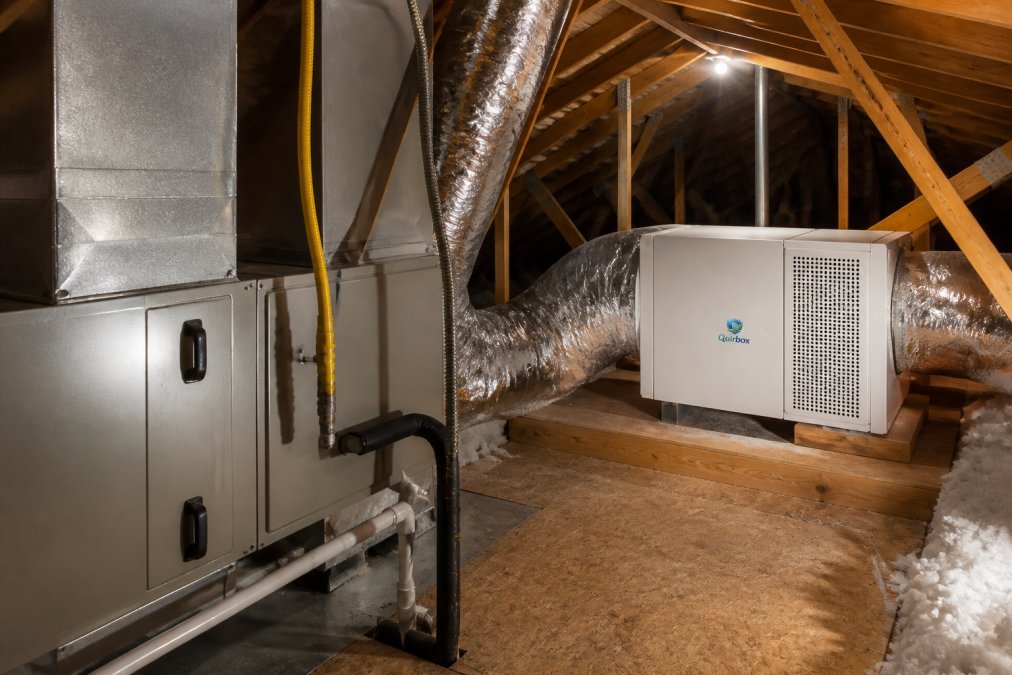
This is why system choice matters so much. Retrofit solutions that integrate with your existing HVAC add resistance to your ductwork. Your AC motor must overcome that resistance, consuming more electricity. In some cases, homeowners report 10-15% increases in cooling costs after installing integrated filtration systems. That's a real, ongoing expense that compounds over years.
A standalone system avoids this entirely. You're not modifying your existing infrastructure. You're not creating additional load on your AC compressor. You're adding a separate system that handles its own air movement.
For homeowners in hot, dusty climates, where AC already runs frequently and costs are substantial, this distinction is significant. Choosing a standalone system preserves your HVAC efficiency while still delivering whole-home purification.
Qairbox operates as a completely independent system. It doesn't touch your existing HVAC or air conditioning. You get hospital-grade purification throughout your entire home without any impact on your cooling system's efficiency or operating costs.
The real answer to whether air purification systems increase energy bills is: yes, but not as much as you might think, and far less than retrofit alternatives. A standalone whole-home system adds roughly 5-10% to your monthly electricity costs for most households, comparable to running an additional refrigerator. You control that cost through fan speed and scheduling. Your HVAC system remains unaffected.
The bigger question isn't whether purification costs money to operate. It's whether the benefit, cleaner air, reduced allergens, better health for your family, justifies that cost. For allergy-sensitive households and families in dusty climates, the answer is usually yes. Schedule a consultation with Qairbox to explore how a standalone whole-home system can improve your indoor air quality without burdening your energy budget.
Frequently Asked Questions
Q: Do air purifiers consume a lot of electricity?
Most air purification systems consume between 30 to 200 watts depending on fan speed and system design. Running continuously at medium speed typically uses less electricity than a standard refrigerator. Whole-home standalone systems like attic-mounted units can be an efficient choice for whole-home air purification.
Q: How much does it cost to run an air purifier 24/7?
At average U.S. electricity rates of $0.14 per kilowatt-hour, running a 100-watt system continuously costs approximately $10 to $12 monthly. A 50-watt system runs about $5 to $6 per month. Your actual cost depends on your local electricity tariff, the wattage of your specific system, and fan speed settings.
Q: Does a whole-home air purification system affect HVAC efficiency?
A standalone whole-home air purification system installed in the attic operates independently and does not modify or strain your existing HVAC system. Because it runs on its own power supply and circulation, it has no impact on your air conditioning efficiency or heating costs. This design eliminates the static pressure and motor strain issues that can occur when air purifiers are integrated into existing ductwork, making it an efficient choice for homeowners concerned about energy bills.
Q: What are energy-efficient air purification solutions for continuous operation?
Choose systems with adjustable fan speed settings so you can run at lower speeds during off-peak hours or when air quality is good. Look for units with high CADR (Clean Air Delivery Rate) ratings relative to their wattage, this means better air cleaning per unit of energy consumed. Standalone whole-home systems can be an efficient choice for whole-home air purification. Keep filters maintained regularly to prevent clogged filters, which force motors to work harder and increase power draw significantly.
This article was written using GrandRanker