Why Indoor Air Quality Is Important: A 2026 Guide

Table of Contents
- Why Indoor Air Quality Is Important for Your Health and Home
- Indoor Air Quality Health Effects You Should Not Ignore
- Sources of Indoor Air Pollution in the Average American Home
- Indoor vs. Outdoor Air: Why Your Home May Be the Bigger Risk
- The Economic Cost of Poor Indoor Air Quality
- How to Improve Indoor Air Quality Throughout Your Entire Home
- Indoor Air Quality Monitoring: DIY Testing vs. Professional Assessment
- Why Indoor Air Quality Is Especially Important in Tightly Sealed Desert Homes
Last Updated: August 2, 2026
Why Indoor Air Quality Is Important for Your Health and Home
Americans spend approximately 90% of their time indoors, where pollutant concentrations can be two to five times higher than outdoor levels, according to the EPA Indoor Air Quality resources. This fact reframes the entire conversation about air pollution. At Qairbox, we work with homeowners across desert climates who discover that the air inside their tightly sealed homes is often the primary driver of allergy symptoms, fatigue, and respiratory discomfort.
Your home's building envelope traps airborne contaminants, combustion byproducts, volatile organic compounds, and biological pollutants in a closed loop. Without adequate ventilation and active air filtration, those pollutants accumulate to levels that no outdoor air quality index would ever flag.
Indoor air quality is the condition of the air within and around buildings as it relates to the health and comfort of the occupants. It is determined by the concentration of pollutants, humidity levels, temperature, and the rate at which outdoor air replaces indoor air.
Indoor Air Quality Health Effects You Should Not Ignore
Poor indoor air quality ranges from minor irritation to serious, long-term disease. The indoor environment is an active exposure pathway that affects cardiovascular health, lung function, and cognitive performance simultaneously.
Respiratory and Cardiovascular Risks
Chronic exposure to indoor airborne contaminants is directly linked to respiratory diseases including asthma, chronic obstructive pulmonary disease, and bronchitis. Particulate matter small enough to penetrate deep into lung tissue triggers inflammation that, over years of repeated exposure, contributes to cardiovascular health problems including elevated blood pressure and increased risk of cardiac events. The American Lung Association state of the air report identifies indoor pollutant exposure as a contributing factor in premature mortality, particularly for children, older adults, and people with pre-existing conditions.
Asthma triggers inside the home are especially problematic because they are constant. Unlike outdoor allergens that shift with seasons, indoor allergens like dust mites, pet dander, mold spores, and cockroach particulates are present year-round.
Cognitive Performance and Psychological Well-Being
Elevated carbon dioxide levels and exposure to volatile organic compounds at concentrations common in poorly ventilated homes produce measurable cognitive deficits. Research in occupational health settings has shown that workers in environments with better ventilation rates score significantly higher on decision-making and information-processing tasks.
Persistent low-grade symptoms like headaches, difficulty concentrating, and unexplained fatigue create a cycle of reduced productivity and increased anxiety. Building-related illness, a recognized clinical category, encompasses these diffuse symptoms that resolve when occupants leave the building. For homeowners working remotely, the home IS the building, making this more than an abstract concern.
Sources of Indoor Air Pollution in the Average American Home
Most indoor pollutant sources are ordinary household items and activities, not industrial processes.
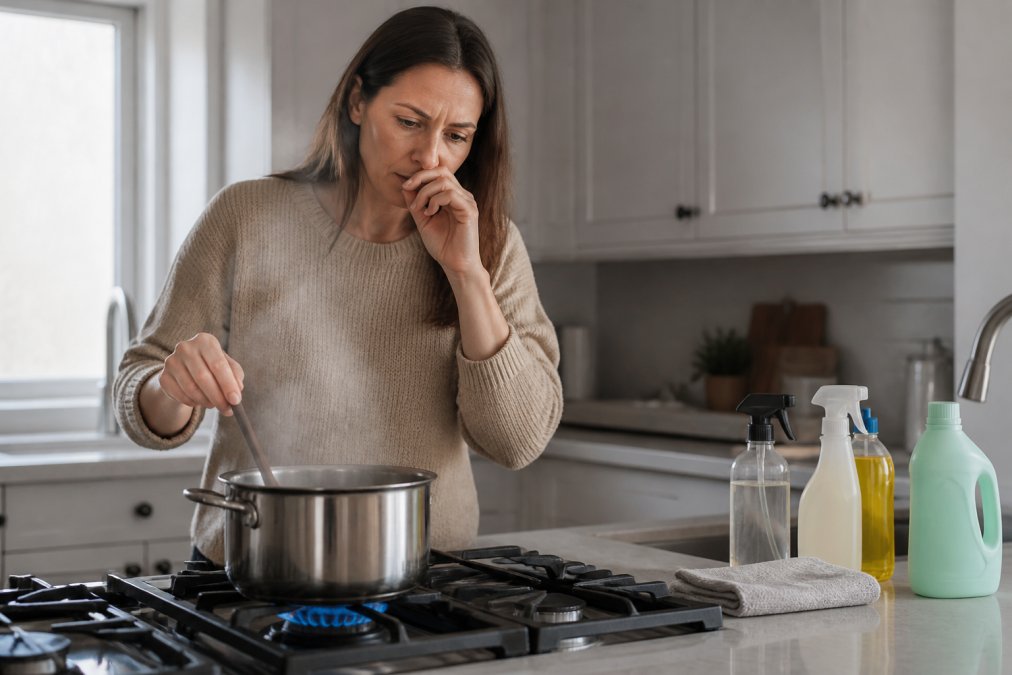
Volatile Organic Compounds, Formaldehyde, and Combustion Byproducts
Volatile organic compounds are emitted by paints, varnishes, cleaning products, air fresheners, adhesives, and pressed-wood furniture. Formaldehyde specifically off-gasses from laminate flooring, cabinetry, and upholstered furniture for months or years after installation.
Combustion byproducts are another major category. Gas stoves, fireplaces, candles, and tobacco smoke all release nitrogen dioxide, carbon monoxide, and fine particulate matter directly into the living space. A gas stove without adequate kitchen ventilation can spike particulate matter concentrations to levels that exceed outdoor air quality standards within minutes of cooking.
Particulate Matter, Mold, Radon, and Airborne Pathogens
Particulate matter enters homes through gaps in the building envelope, HVAC systems without adequate air filtration, and indoor activities like cooking, vacuuming, and burning candles. In desert climates, fine dust particles carry additional mineral compounds that are particularly irritating to airway tissue.
Mold and mildew grow wherever humidity control is inadequate. Mold spores become airborne and circulate through the duct system. Radon, a radioactive gas produced by uranium decay in soil, seeps into homes through foundation cracks and accumulates in lower levels. The EPA radon guidance for homeowners identifies radon as the second leading cause of lung cancer in the United States. Airborne pathogens including bacteria and viruses also survive longer and travel farther in low-humidity, poorly ventilated indoor environments.
Indoor vs. Outdoor Air: Why Your Home May Be the Bigger Risk
The popular assumption is that outdoor air pollution is the primary threat and that staying indoors provides protection. That assumption is wrong.
Outdoor air disperses pollutants through atmospheric mixing. Indoor air does not. Every pollutant generated inside a home accumulates unless actively removed through ventilation or air purification. The building envelope that makes a home energy-efficient also prevents the natural dilution that occurs outdoors.
The air exchange rate of a modern, well-insulated American home can be very low. In desert climates where homes are sealed tightly against heat and dust, that exchange rate drops even further. The result is pollutant accumulation that compounds over hours and days.
This doesn't mean outdoor air quality is irrelevant. During wildfire events or high-pollution days, outdoor particulate matter infiltrates even well-sealed homes. The practical takeaway is that homeowners need to manage both exposure pathways, and the indoor pathway deserves far more attention than it typically receives.
The Economic Cost of Poor Indoor Air Quality
Healthcare costs associated with respiratory diseases, cardiovascular conditions, and building-related illness represent a significant financial burden for affected families. Lost productivity from sick days, reduced cognitive performance while working from home, and the compounding costs of treating chronic conditions all add up.
For homeowners specifically, there are property-related economic consequences. Mold infestations discovered during home sales routinely result in significant price reductions and remediation costs. HVAC systems that circulate contaminated air without adequate filtration accumulate particulate buildup that shortens equipment lifespan and increases energy consumption.
Investing in air filtration, humidity control, and ventilation now costs considerably less than treating the health consequences of chronic exposure or remediating a mold problem that went undetected for years.
| IAQ Problem | Health Consequence | Economic Impact |
|---|---|---|
| High particulate matter | Respiratory diseases, asthma flares | Medical costs, lost workdays |
| Elevated VOCs/formaldehyde | Headaches, cognitive deficits | Reduced productivity |
| Mold growth | Allergic reactions, building-related illness | Remediation, property value loss |
| High CO2 / poor ventilation | Fatigue, poor decision-making | Lost productivity, energy costs |
| Radon accumulation | Lung cancer risk over time | Long-term medical expenses |
| Airborne pathogens | Viral and bacterial illness | Healthcare visits, sick days |
How to Improve Indoor Air Quality Throughout Your Entire Home
Improving indoor air quality requires a layered system that addresses source control, ventilation, and active filtration simultaneously.
Ventilation, Humidity Control, and Air Filtration Basics
Ventilation is the foundation. Increasing the air exchange rate dilutes indoor pollutants and removes moisture before it supports mold growth. Use bathroom and kitchen exhaust fans consistently, open windows during low-pollution outdoor periods, and ensure HVAC systems bring in a percentage of fresh outdoor air rather than recirculating indoor air exclusively.
Humidity control is equally important. The target range for indoor relative humidity is 30-50%. Below 30%, respiratory mucous membranes dry out and become more vulnerable to airborne pathogens. Above 50%, mold and mildew growth accelerates.
Air filtration removes particles that ventilation alone cannot address. Higher-efficiency filters capture smaller particles, including many allergens, at the cost of slightly increased airflow resistance.
A practical IAQ improvement checklist:
- Test for radon (especially in lower levels)
- Check and maintain HVAC filters on schedule
- Install and use exhaust fans in kitchen and bathrooms
- Monitor indoor humidity and adjust seasonally
- Identify and reduce VOC sources (cleaning products, air fresheners)
- Inspect attic, crawlspace, and HVAC drain pans for mold
- Ensure gas appliances are properly vented
Whole-Home Air Purification vs. Room-by-Room Solutions
The room-by-room approach appeals to homeowners because it feels manageable, but portable units only clean the air in the immediate area, require ongoing filter replacement, generate noise, and create visual clutter.
Whole-home air purification integrates directly with the existing HVAC system, treating every cubic foot of air that circulates through the ductwork. Every room receives purified air without visible units, power cords, or rooms left unprotected.
Qairbox installs hospital-grade air purification in the attic, connected to the existing HVAC system without requiring modifications to the ductwork. The system operates 24/7, handles the entire home's air volume, and is completely out of sight and out of hearing range.
Indoor Air Quality Monitoring: DIY Testing vs. Professional Assessment
Monitoring indoor air quality gives homeowners the data needed to make informed decisions rather than guessing.
Smart Home Technology and Real-Time Air Quality Tracking
Consumer-grade air quality monitors can measure particulate matter, VOCs, carbon dioxide levels, humidity, and temperature in real time. These devices connect to smartphone apps and provide continuous data that reveals patterns: air quality spikes during cooking, CO2 rises during the night in a closed bedroom, humidity climbs after showers.
The limitation of DIY monitoring is precision and scope. Consumer sensors provide relative measurements useful for trend tracking but not for regulatory compliance or clinical assessment. They cannot test for radon, specific VOC compounds, formaldehyde concentrations, or biological contaminants like mold spores. Professional assessment fills those gaps.
Professional indoor air quality assessment involves calibrated instruments, laboratory analysis, and interpretation by trained specialists. It produces quantitative data against established exposure limits and provides actionable mitigation strategies. For homes with occupants experiencing unexplained health symptoms, or for homes being purchased or sold, professional assessment is the appropriate tool.
Smart home integration adds automation that makes monitoring actionable. When an air quality sensor detects a particulate spike, it can trigger the HVAC system to increase circulation, activate a whole-home purification system, or send an alert to the homeowner's phone. According to ASHRAE indoor air quality standards and guidelines, establishing clear ventilation and monitoring protocols is foundational to maintaining healthy indoor environments in both residential and commercial buildings.
Why Indoor Air Quality Is Especially Important in Tightly Sealed Desert Homes
Desert homes present a specific and underappreciated IAQ challenge. The combination of extreme heat, low outdoor humidity, high ambient dust, and the need for continuous air conditioning creates conditions where indoor air quality becomes even more critical than in other climates.
Tight building envelopes are a design requirement in desert climates. They keep conditioned air in and extreme heat out, but they also dramatically reduce the natural air exchange rate. Fine desert dust particles, which carry mineral compounds and biological material, infiltrate through every small gap and accumulate in HVAC systems and living spaces.
The HVAC system runs for extended periods in desert climates, making it the primary vehicle for air distribution. If the system lacks adequate filtration or an integrated purification component, it continuously recirculates whatever contaminants are present in the ductwork and indoor air.
For homeowners in Phoenix, Las Vegas, Tucson, Palm Springs, and similar desert communities, the question of why indoor air quality matters is not theoretical. It's the difference between a home that makes allergy symptoms worse and one that actively supports respiratory health. Qairbox was specifically designed for this environment: hospital-grade purification integrated with the existing HVAC system, installed in the attic for silent 24/7 operation, with no visible equipment and no disruption to the home's interior.
A common mistake in desert climates is assuming that because outdoor air quality looks acceptable on the air quality index, indoor air is fine. The two are not the same measurement.
Poor indoor air quality is a manageable problem with the right system. For homeowners in desert climates dealing with persistent allergens, dust infiltration, odors, and chemical irritants, Qairbox delivers hospital-grade air purification integrated directly into the existing HVAC system, operating quietly from the attic 24/7 without any visible equipment or ongoing complexity. Schedule a consultation with Qairbox and get a whole-home air purification solution designed for the specific demands of your climate and household.
Frequently Asked Questions
What are the main reasons indoor air quality is important?
Indoor air quality is important because Americans spend roughly 90% of their time indoors, where airborne contaminants like particulate matter, volatile organic compounds, mold, and radon can accumulate to levels that harm health. Poor indoor air quality is linked to respiratory diseases, cardiovascular health problems, aggravated asthma, and reduced cognitive performance. Because indoor environments are often sealed tightly for energy efficiency, pollutants have fewer ways to escape, making air purification and ventilation essential.
How does poor indoor air quality affect your health?
The indoor air quality health effects range from short-term irritation to serious long-term illness. Short-term exposure to airborne contaminants can cause eye irritation, headaches, and fatigue. Prolonged exposure to pollutants like formaldehyde, combustion byproducts, and mold spores is associated with respiratory diseases, worsened asthma and allergy symptoms, cardiovascular health complications, and in extreme cases premature mortality. Children, older adults, and people with existing conditions face the greatest risk from sustained exposure.
What are common sources of indoor air pollution?
Sources of indoor air pollution include volatile organic compounds off-gassed by paints, flooring, and furniture; combustion byproducts from gas stoves and fireplaces; formaldehyde from pressed-wood products; radon seeping through foundations; mold and mildew from excess humidity; pet dander; dust mites; and airborne pathogens. In tightly sealed homes, especially in desert climates, these pollutants accumulate quickly because the building envelope limits natural air exchange, making active air filtration and ventilation especially valuable.
How can I improve the indoor air quality in my home?
To improve indoor air quality, start by increasing ventilation rates where possible, controlling humidity to prevent mold growth, and using high-efficiency air filtration. Replace standard HVAC filters with higher-rated options, address known pollutant sources like unvented combustion appliances, and test for radon if you have not already. For whole-home coverage without multiple standalone units, an HVAC-integrated air purification system treats every room simultaneously, which is more consistent than room-by-room devices and requires less ongoing maintenance.
What tools are available to measure indoor air quality?
Indoor air quality monitoring options range from consumer-grade smart sensors that track carbon dioxide levels, particulate matter, humidity, and volatile organic compounds in real time, to professional assessments that test for specific contaminants like radon, formaldehyde, or mold. DIY monitors are useful for ongoing awareness and spotting trends, while professional testing provides precise measurements against EPA exposure limits and identifies pollutants that consumer devices cannot detect. Using both approaches together gives the most complete picture of your home's air.
Are there US regulations for indoor air quality in homes?
Residential indoor air quality in the US is not governed by a single mandatory federal standard, but the EPA publishes guidelines and exposure limits for specific pollutants including radon, carbon monoxide, and particulate matter. OSHA sets workplace exposure limits that apply to commercial buildings. The EPA's Indoor Air Quality program provides voluntary guidance for homeowners and building managers. Some states have additional requirements, particularly around radon disclosure during home sales. Following EPA recommendations is the practical benchmark for most American homeowners.
Does a tightly sealed home make indoor air quality worse?
Yes. A tightly sealed building envelope reduces the natural air exchange rate that normally dilutes indoor pollutants. This is especially relevant in energy-efficient desert homes built to minimize heat gain, where doors, windows, and insulation limit airflow. Without active ventilation or air purification, volatile organic compounds, particulate matter, carbon dioxide, and allergens accumulate to higher concentrations than they would in a drafty older home. Whole-home air purification integrated with your HVAC system is one of the most effective mitigation strategies for this type of construction.
This article was written using GrandRanker